Almost Everything You NEED Can Be Learned As a Child, Almost Everything Adults SHOULD BE Most Never Are. Do you have everything you need?
As few as 1 in 100 people pay attention to important and even urgent information even if it's coming from someone they like and/or look up to, if the alternative is something humorous, silly, and not important at all.

Initial content on this site is written from the perspective of us having evolved, or devolved, our society to a point where people have impossibly short attention spans of as little as seconds to a few minutes.
Many studies have been done on attention spans, with one frequently cited as claiming a time as short as 8 seconds, which, if true, is about on par with a goldfish[1].
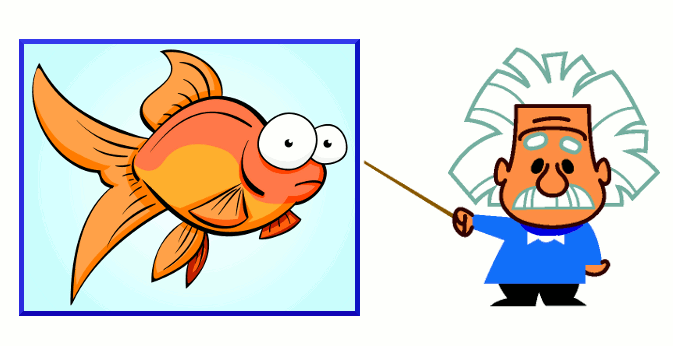
Words are often not taken seriously, and even when people do take the time to read the words the meaning, message, or point is often not really "heard" or comprehended, let alone heeded. And misinformation and disinformation, which has been with us since before the Internet but only made worse by ill conceived technologies means many people also often don't know what to believe. Despite that last point being one of the easiest to address, because it isn't hard to know how to discern good information from bad.
Let's circle back to finish this thought a little further on...
How do you prioritize What's Most Important®?
Since we're already past that 8 seconds let's stop here to focus on time, words, messaging, importance, and how you'll prioritize whether to keep reading, and if you do what you'll do with what you learn.
While the frequently cited 8-second research[1:1] was done elsewhere I've done plenty of work and/or hired firms to conduct surveys and research in an effort to learn why people often unknowingly or intentionally choose not to prioritize truly important and time sensitive things that carry great legitimacy over those that do not.
A Quick Overview of Almost Everything on This Page
1. Almost Everything You NEED Can Be Learned As a Child, yet many never do regardless of age because things aren't designed with you knowing as the priority.
2. The word "You" can also be replaced with "We" because it applies to Almost Everyone: You, me, everyone.
3. Most of the things you NEED can be had without paying exorbitant prices, or in many cases anything at all, responding only to endless advertising or marketing or just continuing to do so because it's always been done that way and is what everyone else does.
4. Many of the things everyone NEEDS they don't even know are available, or where or how to get them.
5. Among the biggest reasons for the above is because most people have grown accustomed to just accepting what's offered to them or what everyone else is doing; And words have been so misused so often, especially advertising, marketing, content or promises that ring hollow that people often don't know what to believe, let alone what to pay attention to or act on.
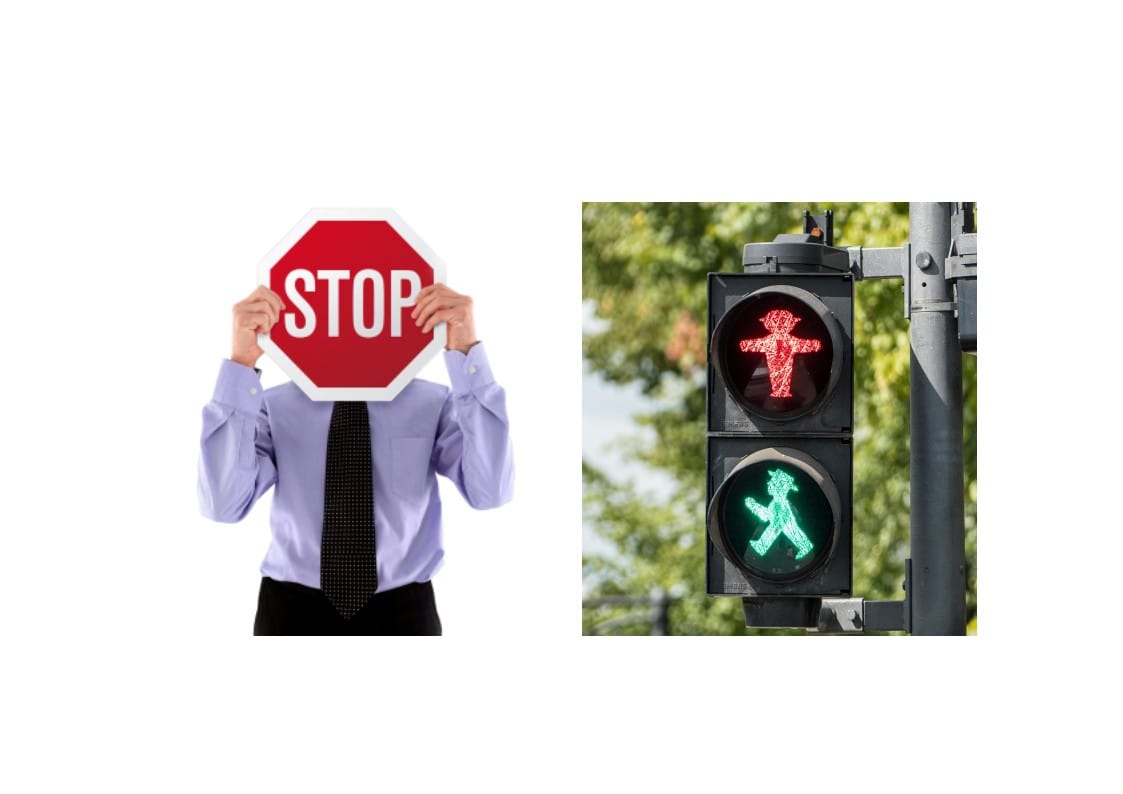
6. Despite all of the progress made in developing language, literacy, and better ways to communicate, aside from standardized symbols like the stop sign and traffic light pictured below, there are few agreed upon words or phrases that people agree upon taking seriously and prioritizing as important and timely.
7. This initiative is able to address Almost Everything mentioned above.
Are you tuned in, or tuned out?
Even early in my career I'd learned that people often don't pay adequate attention even in a one-on-one conversation with someone sitting right in front of them, irrespective of the quality, legitimacy, or importance of what is being said.
And people often lose focus or start to ignore emails (assuming they haven't adopted the habit of largely favoring texting or even ignoring emails over SMS text-length messages) even after just a few sentences. For those with short attention spans three (3) sentences or lines is often the limit, and in recent years there are signs it may be falling to only two (2) before those people's attention spans wander.
What causes you to pay attention?
It's been well studied and proven (citations and research references readily available) that many people prioritize what they pay attention to, believe, act on, etc., not so much on the facts or merits but on a variety of cognitive biases (including some, like favoring those you know, are familiar with, or relate to, which actually can be quite helpful, but only when applied rationally). Some of the greatest influences are advertisements, marketing, or content crafted to appeal to people's emotional buttons. And in a celebrity, fame, and influence obsessed World many place more emphasis on those factors than the merits. A small number of hugely successful companies have even admitted as much. Which is why advertising and marketing frequently says little or even nothing about the merits, benefits, features, or facts about the product or service. But rather focus instead on appealing to people's emotions.
Important and urgent information routinely takes a back seat to What's Most Important®
If there's a researcher out there who wants to do more with this it would be interesting to see what results you come up with. But research on this end shows something that many would not expect. And that is that even when information is communicated by people who fall into the aforementioned categories, while those on the receiving end absolutely do pay more attention, that attention is not the same for all content or messaging. Even when someone the listener or reader admires, relates to, likes, considers a celebrity, etc., is doing the talking, people still pay more attention to things that appeal to their emotional buttons rather than What's Most Important®⸮?
The ratio of people who will pay attention to something humorous, silly, etc., and entirely inconsequential, is often as high as 100 to 1, as opposed to the comparatively small number of people who will pay attention to even critically important and time sensitive information. Or to put it another way, as few as 1 in 100 people pay attention to important and even urgent information even if it's coming from someone they like and/or look up to, if the alternative is something humorous, silly, and not important at all.
If a Tsunami was approaching would it matter who pointed it out?
That isn't a hypothetical by the way. There have been numerous recorded instances of tsunamis or even rogue waves visibly approaching beaches, especially where the water retreated first, where there was time to retreat to safety but not all heeded the warnings. The same has happened with all manner of other scenarios, such as those who could see it made sense to get out of thunder and lightning storms, or avoid the quintessential thin ice, etc., and those who ignore the warnings. References have been made for thousands of years including in the Bible of the idea of out of the mouths of babes, to make the point that age, young or old, shouldn't negate the validity if the words being spoken are true.
Hammering home the point
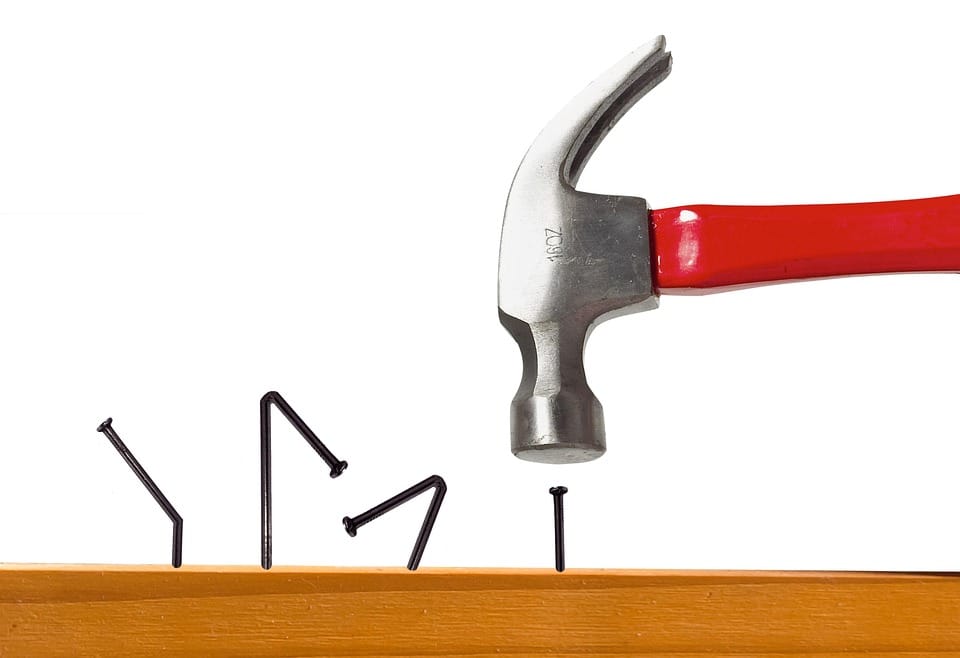
Another timeless concept is how it's often been said that despite the millions of hammers and billions of nails sold each year few people are truly interested in either. Rather the point, both figuratively and literally, is the desired result, making a meaningful connection between two pieces of wood and connecting them together. If there were more efficient ways to make the needed connection not only would people not buy so many hammers and nails, but that is exactly what happened over time as other methods of connecting materials became available.
In the same way much of the wording on this page would be unnecessary if there were words that enough people could agree on that their meaning, importance, priority, etc., was understood and acted upon accordingly.
Is it really true that people agree on more than they disagree?
Though it's often said that people agree on more than they disagree it's more something people try to convince themselves of than is true. Some words, signs, and symbols representing things positive that people are often looking for, like "where is the bathroom?," or Green for Go, are positive examples, while things like rating scales for storms, hurricanes or tornadoes are examples of commonly adopted methods of communicating to people things they should avoid.
Similarly one of the first goals of this initiative is to find words that enough people can agree upon about things any objective, rational, thinking person would truly want to have fulfilled as a need, and avoid as a liability.
You could consider it an effort to develop a kind of Emergency Alert System (EAS) for good, but with meanings that can apply equally as much to positive opportunities as opposed to just avoiding or dealing with bad things when they happen. For now, just as a thought for comment and feedback how about something like: ”Universal Alert System (UAS)”? [for Almost Everything You NEED]
People (most anyway) pay attention and act accordingly when presented with traffic signs or lights, without being advertised or sold to, influenced or persuaded because they recognize the importance and priority of doing so. A primary goal of this initiative is to find words, phrases, or images that people can agree deserve to be treated with the same level of priority and importance!
Consistent with the theme of this initiative this would not require any new technology and it certainly wouldn't require you to be dependent on a company to provide it, or for you to have to pay for it, though as with many things technology or related services could make it easier and more efficient to avail oneself of. Unlike many of today's service offerings where sayings like "if you aren't paying for it, you aren’t the customer you’re the product" are more truth than fiction, not so here. When you see a universal bathroom sign, or a stop sign, or walk or drive forward when a light turns green you don't pay to use the wording or symbols of either.
What words or phrases would you suggest to render the rest of what’s on this page unnecessary?
If there were already a Universal Alert System (UAS) for Almost Everything You NEED and words and/or symbols to go along, most of the words on this page, and even what you've read already could be reduced to just a few key words or phrases, and please remember that is the goal.
If this makes sense to you, please subscribe so that you can make comments or suggestions about words and phrases that you think would be good candidates.
But in the meantime, since no such Universal Alert System (UAS) [for Almost Everything You NEED] exists, let's circle back to where we left off near the beginning of this article, just after the goldfish illustration and discussion about attention spans.
Many studies have proven just how little people pay attention
People, ranging from businesses to researchers to just those who like to make a point have been proving just how much people don't pay attention since before the Internet.
Long before the Internet, for example, one industry looking to reduce its hardcopy paperwork and mailing burden by proving hardly anyone ever read the periodic account or agreement related updates or notices they were already getting, included in the fine print of one of its periodic mailings to customers a brief note informing them that if they simply brought the notice to any nearby office location they would instantly be entitled to a check for $10,000. No one did...
Later as the growth of the Internet and online Web made it apparent that, still, hardly anyone reads or pays any attention to either the agreements or terms they agree to when signing up for things online, or what's contained within any written materials or notices they receive as a customer, numerous individuals and organizations replicated the aforementioned experiment by including similar notes within the wording of their agreements, though the amounts the reader would receive if they happened to pay attention were generally lower, though not always.
The effort that may have gone the furthest to prove the point to-date was a 2016 study called “The biggest lie on the Internet: Ignoring the privacy polices and terms of service policies of social networking services.” Written by Jonathan Obar at York University, and Anne Oeldorf-Hirsch, University of Connecticut.
TOS agreements require giving up first born and users gladly consent - Ars Technica
The above refers to end users, customers, clients, patients, etc., but even fewer people realize that most people on the provider's side, people who work for the companies behind the agreements, also haven't read their own company's agreement either, even though they expect their customers (who likely haven't read it) to agree to its terms.
If you're among those people who do read and know that words can matter the first thing to note is that this site is likely unlike any other you've read or will find.
Just one of the many ways this effort is different is that it is presenting you with a scenario that is almost exactly the opposite of those described above. Meaning a no fine print, well intentioned, good faith, sincere effort to get the word out that, as the first part of the subtitle states:
Almost Everything You NEED Can Be Learned As a Child
It's impossible to fit the many further, fuller, greater, and more expanded meanings into the main titling, so let's start expanding on that here.
First, words like "need to know" and/or "can be had" also apply. So the first part of the subtitling could also just as easily read:
Almost Everything You NEED To Know Can Be Learned As a Child
Almost Everything (age appropriate) You NEED To Have Can Be Had As a Child, As Well as Throughout Life
The title, "Almost Everything", has multiple other meanings, one of which is that almost everything the average person needs (but may not be aware of, cannot afford, considers out of reach, etc.) is likely available to them. That they aren't availing themselves of what's available occurs for a variety of reasons, but among the main reasons are:
1. Due to the aforementioned attention span issue their focus is so much in the wrong places they don't even know what better options in life, or business, are available.
2. They are comfortable and complacent contributing to the Status Quo (one of the most powerful forces of human nature) by just continuing along with whatever is offered to them, or they find quickest or easiest. Many people just go along to get along, as the saying goes.
3. Because of the obstacles mentioned above, which aren't the only roadblocks people put in their own way, or, worse, in the way of others, even people trying to help them, the people in a position to help you achieve or get everything you need and deserve often see no point in making the effort.
I know because it's something I first learned as a very small child, from adults and mentors who knew. Then came to see firsthand for myself, from childhood through adulthood and career. And over that time I've met some of the people in that third (#3) category mentioned above, people in a position to help other people get what they need out of life, but largely stay quietly out of the picture because they've come to feel, justifiably so, that it's not worth the effort. And I also know because over time I eventually became one of those people myself.
Generational Age and Other Stereotypes Don't Change What's Most Important®
Despite the fact that the saying out of the mouths of babes has been around for thousands of years, and the wisdom of giving due consideration and respect to age and wisdom, the human tendency to ignore history means both are routinely ignored. Younger people often ignore or disregard those they perceive as being older while older people often ignore or disregard those who are younger, including ignoring studies that show the average person on the younger side of the equation typically assumes older or "old" to be anyone 15 to 20 years older even though they'll be that age themselves soon. And likewise those older often forget that not long ago they were the same age as those younger.
I was fortunate to have some really great mentors and role models even as a very young child, including parents who placed an emphasis on literacy and reading. One book that contributed to my own personal Almost Everything You NEED To Know knowledge and perspective was a children's book published before I was born that while intended to be lighthearted and humorous nonetheless taught some very serious and useful concepts, useful to both children and adults alike.
The book was Bennet Cerf's Book of Laughs.
It contains numerous stories, all accompanied by illustrations, that though fictional tend to mirror real life. One that stood out to me the most as being especially significant and applying to many real-life situations was the illustration below:[2]
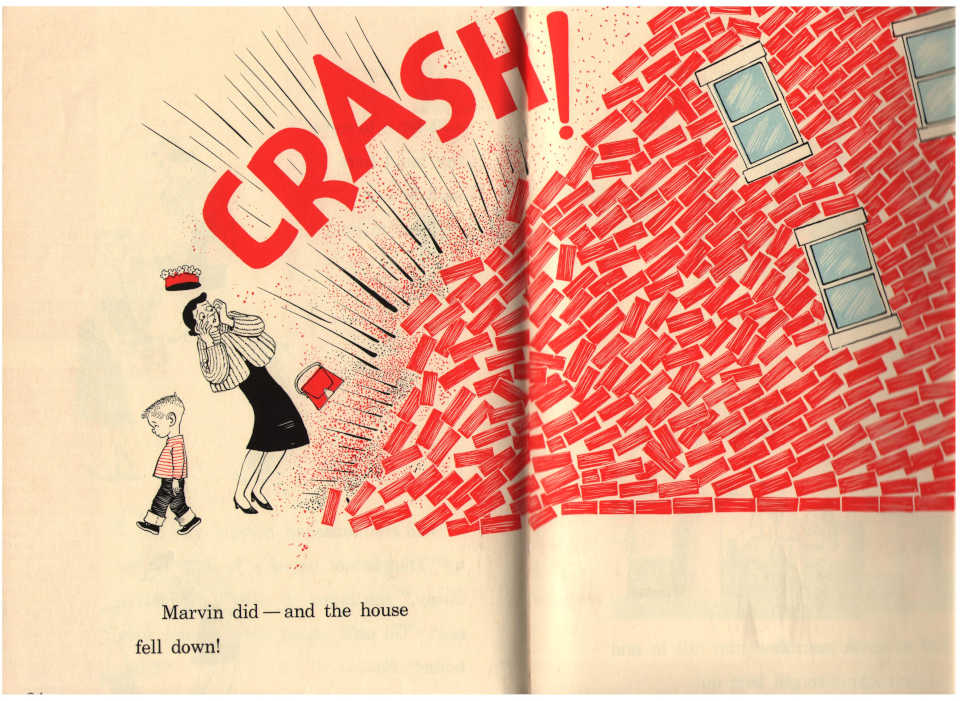
The older adult woman does not nor does she try to listen to, perceive, or truly determine if there is any merit to what the very young boy, Marvin, is trying to tell her. Which is that he is the only thing preventing the building from falling down. The woman, paying no attention and viewing Marvin only through her lens of him being a child not to be taken seriously, chastises Marvin for "just standing around" and insist that he should be elsewhere. Not wanting to disobey an adult Marvin walks away. And, just as he'd explained to her would happen, the building comes crashing down.
Sadly people ignoring critically important information isn't just limited to adults ignoring children. People frequently ignore critically important information irrespective of how legitimate or factual it may be, often with similarly disastrous results.
People equally ignore critically important POSITIVE information denying themselves and others opportunities for good and to get Almost Everything They NEED
There are countless people who do good and kind gestures, often quietly, without regard for recognition or being in the limelight. And while the people who do so are as varied as our society is diverse two well known examples are people of faith and the so called Secret Santas. Not always sharing exactly the same beliefs but having in common doing most of their good without being known.
But, while there may sometimes be overlap, for the most part these are NOT the people I'm referring to.
In fact I've known or know people who, quietly, help others out with almost every NEED (though typically not all at once), with the key word being about needs verses wants, because the two can be very different. Needs can be things like food, housing, transportation, schooling (as in college tuition), childcare, etc.
And once again while there may sometimes be overlap, for the most part these are also NOT the people I'm referring to.
One reason being that some people reading the above might think it is only referring to people who help those who are less fortunate. Whereas here the Everything in "Almost Everything" includes individuals and organizations from all walks of life and every socioeconomic level.
The even bigger difference is that the people being referred to here are in a position to address almost every issue or need that makes life non-optimal for most people most of the time.
If A Gift Is Offered And No One Appreciates It, What Is Its Impact?
This question was partially inspired by two other things. One is a quote that evolved over time to become one of the greatest philosophical quotes and questions of all time: "If a tree falls in the forest and no one is around to hear it, does it make a sound?"
The other was the title theme for letters or messages I used to write around the holidays for family, friends, colleagues, and clients, usually titled: "The Greatest Gift".
Over time such writings became less frequent, so much so that up until mentioning it here it's been years since I've written on the topic. Mainly because of the third (#3) item in the three item list a few paragraphs back. It's often said that many people don't know what they want in life, a saying that few would be surprised by. But what is not just surprising but quite puzzling is the percentage of people who either cannot figure out what the greatest gift would be to them, or, worse, do not recognize or respond when an opportunity for what they say they want presents itself.
Even more surprising is the degree to which this also applies to organizations, both for- and non-profit. It's literally shocking the degree to which some organizations respond poorly or not at all to prospective or existing customers, clients, or donors who are simply responding to the organization's own appeals, messaging, or marketing.
Corrtive™.org A One-Page Legacy Pilot Website
Not so optional and recommended reading
If you would like to read more content related to what's just been said above you may wish to view the content from the legacy pilot Website Corrtive.org , which has since been moved to and archived on this site, Almost Everything here on go.grpmax.com. You can access the legacy content at the URL below:
One heading and sentence/paragraph from the former Corrtive.org Website poses an important question that is just as applicable here, and so basically the same wording, other than updating the Website name, is copied below:
What Form and/or Structure Do You Think This Initiative Should Take?
Does a new type of entity, or at least a category or description, need to be created or are existing categories such as corporation, nonprofit, Benefit Corporation, etc., sufficient?
At minimum my hope is for this initative to be as member driven as possible. And while I'm not sure how practical it is to the degree practical as much member owned as possible as well.
To the degree that you're highly unlikely to find elsewhere what is available to you here that is its purpose. However, it cannot be stressed and overstated enough that one of the main goals of this initative is to provide those interested with the knowledge and tools so that they aren't dependent on anything or anyone more than necessary, including this initiative itself.
More about the choice of the title: "Almost Everything"
Long ago in a galaxy not so far away, right here in our own backyard in fact, I wrote the first best selling computer book of its kind: Computers, The Plain English Guide: Almost Everything You Need To Know About Computers, Even If You Don't Know Anything About Computers.
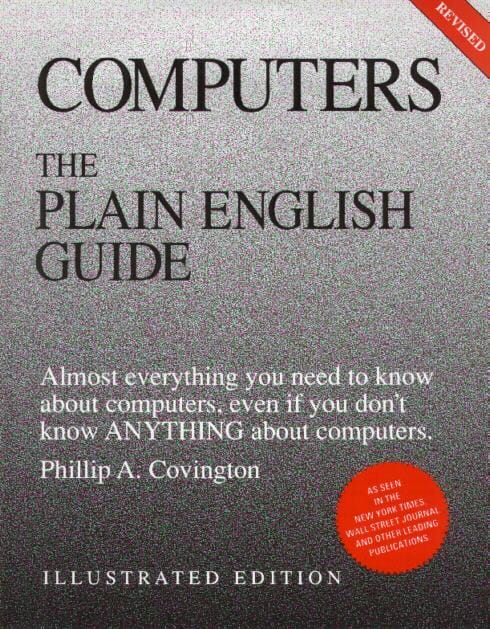
The Plain English Guide reached all four corners of the globe within four months of release, and was the most popular book prior to the Dummies® series.
Over the years since then hundreds of concepts, names, and titles were considered for this initiative, including those that have already seen use or new ones. However, especially as a still potentially preliminary or interim title for this initiative, the first two words of the subtitle of my book, Almost Everything, seemed more than appropriate now for the same reasons those words were used then.
For many years after the last edition of the book was printed I heard from readers all around the World encouraging me to keep updating the book and putting out new editions. However, I was aware of the aforementioned biases detailed above about people's preferences, with books that call their reader a dummy or idiot having been just one symptom of a much bigger trend. Knowing that it was likely to only get worse and not better. And having knowledge and ability that covered much broader ground than just those kinds of computer and technical concepts, my focus shifted to efforts like what you see here.
These efforts have been ongoing throughout my life and career, in this kind of format "officially" since 2013, though, like Corrtive.org, not generally public until now.
There is much, much more that could be said not only about this topic, but each topic discussed on this page. But if there aren't enough people within that 1∶100 ratio explained earlier, who are interested in, take the time to read, comprehend the significance of and respond to anything that fits on the left side of that ratio, it makes little if any difference how many words are used, nor how important the content or message is.
The intention here is not to be just another blog or newsletter, nor to constantly pump out new content absent readers expressing an interest in wanting more
Even then the point is still not to just keep pumping out content for the sake of doing so. Rather, hopefully with reader engagement and participation, to as described earlier try to find words that people can agree on for communicating critically important and/or urgently needed information to actually make it possible for a sufficient number of people to get Almost Everything they NEED to make a positive difference for the better.
In other words, the hope is that you as a reader through your comments and/or emails can help drive forward progress, including helping determine what comes next.
Which of the areas explained above are positive changes for the better in life, work, and elsewhere, that you feel should be prioritized next?
So while it's possible additional content may be posted, of which an enormous quantity is already available (from this initiative), for a time the content here within this post will be considered to be more than adequate to get the conversation and process started. And will serve double duty as both an extension of the About page and the first featured post appearing on the Homepage.
The card requirement is set at almost as low an amount as is practical for most payment processors
It's more for human verification and to try to attract only real people who are really interested in order to reduce the number of signups and/or posting of comments by scripts, bots, or real people who just like to spam.
If you choose that option your payment will be securely processed by Stripe, which means none of your payment information is retained either by this site, or the Ghost.org platform it runs on. Most payment processors frown on transactions less than $1 dollar. The signup cost is set at $1.50 to allow room for it to be discounted and still not be less than $1. And the purpose is not to try to entice prospective members with special discounts, sales, etc., because Almost Everything simply isn’t that kind of site. Instead at some point discounts may be offered for those who are already engaged in some of the good works mentioned on this site. As likewise there are likely at some point to be discounts or even free signup for legitimate nonprofits or those who do similar work, etc.
For now anyone can sign up for free to have access to content like this, but you won't be able to post comments unless you pay the trivial signup amount and become a member to indicate you're a real person who is seriously interested.
Footnotes
Reference to people having attention spans shorter than goldfish, according to some studies, like those in 2015 that found that in the age of technology the human attention span had fallen to only 8 seconds, have been moved to the Corrections page.
↩︎ ↩︎The copyright status of Bennet Cerf's Book of Laughs is assumed to be within the Public Domain, or at minimum the use of the one illustration here falls within Fair Use. If this is not the case and you are someone holding a valid active copyright who feels this usage is a copyright violation please make contact appropriately. ↩︎